Wednesday, March 25, 2009

Foraminifer-what?

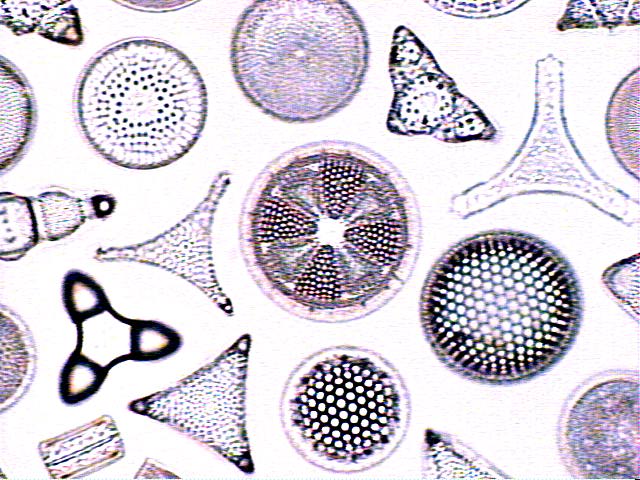
While taking a practice GRE style subject test, I stumbled upon a question asking which of the organisms is not photosynthetic. My choices were cyanobacteria, diatoms, dinoflagellates, foraminifera, and rhodophyta.


I selected diatoms, because from what I remembered I thought that they were creatures that lived in rocky substances or soils, and have a crystallin look to the organism.


A first look at the organism on the left does not reveal anything that would lead it to be photosynthetic, but it is. They do indeed have chloroplasts and are photosynthetic.

The other answers that eliminated are cyanobacteria, dinoflagellates, and Rhodophyta. I eliminated cyanobacteria because I knew that organism got its name from having a cyan color, predominately because it is very photosynthetic. It is a cool organism that is a bacteria and photosynthetic at the same time. I also eliminated dinoflagellates because I distinctively remember that organism being photosynthetic. Under a light microscope it is easy to see the green color from the chloroplasts withiin that organism. The last organism that I eliminated was Rhodophyta. I remembered that this group was a reddish brown algae, and I believe all algae is photosythetic.

I was left with diatoms and Foraminifera. So what exactly is Foraminifera? They are a group of amoeboid protists that undergo a process where they take in algae, and then can temporarily use the plastids for photosynthesis and can be used by the Foraminifera. So in the end, the "forams" are not necessarily photosynthetic in it themselves, but they can use photosynthesis through algae that they take in.

I obviously did not know all of this come time of the question, but the more I look at it, it seems as if it is somewhat of a confusing question, because the "forams" at certain points are photosynthetic, but without the algae they are not. Someone that knows a lot about all five of the organisms in the question might nail this problem, but others may end up arguing with it.

Tuesday, March 24, 2009

Where does energy come from?

"The chemical reaction involved in respiration are virtually identical between prokaryotic and eukaryotic cells. In prokaryotic celss, ATP is synthesized primarily on the inner plasma membrane. Where are the corresponding reactions likely to occur in eukaryotic respiration?"

The answer to this question is on the inner mitochondrial membrane. Adenosine Triphosphate (ATP) is a high-energy molecule that stores the energy needed to accomplish just about every form of work. ATP is generated by food that we eat being oxidized. The energy taken from this process forms ATP.

Mitochondira are where ATP is manufactured. It is formed from the energy stored in food. Atp is produced through a pracess called respiration, which uses oxygen to generate energy. This process can be used to rapidly produce ATP used in the body.

Saturday, March 14, 2009

Nix the ban on stem cell research.

Not that the restrictions on stem cell research set up during the Bush administration were so much a ban, but many of the restrictions put in place were removed by way of Obama's recent executive order. The executive order allows the federal government to fund embryonic stem cell research. The major form of stem cell research previously involved use of induced pluripotent stem cell (iPSC) lines (which are derived most commonly from adult somatic cells instead of the controversy-laden embryonic lines).

Obama recognized that this switch in direction demands a certain level of ethical discretion, and as such required the NIH to develop the rules regarding medical ethics involved in the process of obtaining embryonic stem cell lines. Supporters of the executive order see promise for potentially treating some of human kind’s most devastating diseases and disorders. Some religious officials, however, disagree with the way Obama is going about furthering stem cell research. Surprise: people agree and people disagree. I’d personally like to explore some of the middle-ground options before completely nixing the conservative restrictions previously in place regarding the matter. I’m thinking it’s about time for me to do some google-searches on the practical differences between the use of iPSC versus embryonic stem cell lines. I'm also interested in seeing what others think about the policy shift.

Tuesday, February 17, 2009

Everyone loves warm weather, but is it more deadly?


A blog post from Oh, For The Love Of Science! talks about the West Nile virus. This is a very dangerous disease that was first seen in the United States in 1999, which is said to have been the hottest and driest year in history. A slight increase in temperature, as little as 2 degrees, can greatly increase the spread of this disease. Higher temperatures can magnify the infections of this disease, there is a shorter time period from when the infection occurs and symptoms appear. Higher temperatures also increase the survival rate of the virus. So the prediction from this article is that "as our climate changes, more mosquitoes will be able to infect more people, more quickly and in more places."

Comparing two anesthetic techniques: sciatic-femoral nerve block and regional spinal anesthesia

I reviewed an article from a recent issue of the Journal of Clinical Anesthesia. This journal is very interesting to me and includes reviews of different methods, case studies, and other physiological experiments with anesthesia. The purpose of this study was to determine which of the two anesthetic methods worked more efficiently and effectively for outpatient knee arthroscopy. This practice was done as an ambulatory surgical procedure, which means that the patient will go home the same day as the surgery barring any unseen complications. The two methods studied were a peripheral nerve block to the sciatic-femoral nerve and regional spinal anesthesia. Arthroscopic knee surgeries are very common today, and it would be interesting to know if one method worked quicker because then outpatient knee surgery centers could possibly get more surgeries done in one day, thus making more money. On the other side of the coin, patient satisfaction is equally as important. Another question that was asked was whether or not the patient would have the same anesthesia practice conducted again if they were to have surgery again. A randomized survey was conducted to determine if a combined sciatic-femoral nerve block allows the patient to be discharged quicker than a spinal anesthesia technique.

Without having any knowledge about anesthesia besides what I have purely observed, I decided to do research on the two techniques, because detailed information was not included in the article. The combined sciatic-femoral nerve block is exactly what it sounds like. It is a combination of two nerve blocks on each the sciatic and femoral nerves, which will numb the lower extremities of the body. It was noted that few surgeries can be performed with just a sciatic nerve block, but with the combination of the femoral nerve block patients do not endure as much postoperative pain. Also of note that some administrators of the anesthetic have had trouble with this technique, but I do not actually know how difficult this block is to perform. Some of the websites I came across gave pretty in depth instructions on how to perform this procedure. The other technique used was a spinal anesthesia procedure which involves injection of the anesthetic bupivacaine, although others are used as well. This technique allows for surgery to occur with no pain in the area of choice. If the technique is done the right way, some surgeries can be performed with the patient wide awake. It seems to me that this procedure is done for a good amount of surgeries on the lower half of the body as well, just like the sciatic-femoral nerve block. The spinal anesthesia procedure allows for surgeries on the abdomen, hernias, and caesarian sections as well as others. One of the difficulties with this procedure is that it may not be as comfortable, and the right amount of anesthetic has to be used because if too much is used the diaphragm can be affected, seriously complicating breathing.

Fifty patients were studied with twenty five of them receiving the spinal anesthesia regional technique, and twenty four of them receiving the sciatic-femoral anesthesia procedure. One patient was not included in the sciatic-femoral nerve block group because of failure of the regional technique, so he was not included. There was not a statistically significant difference in the total operating room time, duration of surgery, or surgical preparation time between the groups. The combined sciatic-femoral nerve block took on average six minutes longer to perform. The groups did not differ in pain determined by a visual analog scale assessment every fifteen minutes until the patient was discharged from the hospital. The most important aspect is that all patients reported that they would have the same anesthesia procedure performed if needed in a future operation.

I do not think hospitals or ambulatory surgery centers should consider one procedure over another because they think is faster, because this study shows that there really isn’t a huge difference, if any. Patient care, safety and satisfaction are always primary concerns for any surgery. I found it interesting that each of the groups said that they would have the same exact anesthesia technique performed if need be, without knowing if the other procedure would be more comfortable or not. Future studies should include patients that have had both types of procedures performed, to see which one seemed more comforting to them. This study seems like it would not be hard to perform, and could be very informative. I learned a lot from this study, and learned even more in doing my own research on the two techniques. It is very interesting to me how many different types of anesthesia there are, and how they act physiologically on a person’s body before, during, and after surgery.
Wednesday, February 11, 2009

Conan goes crazy because of New York Times mistake

If anyone knows the Conan O'Brien show, every once in a while he gets a little angry at the way the New York Times states some things, that to him are clearly wrong. Check out the video in this blog, it is quite hilarious.

As a casual viewer of the Conan O'Brien show, when he makes his transition to the Late Show, I hope he continues to do this kind of stuff, because it was very funny. He goes out of his way to slightly educate on himself on the subject that the person made a mistake on, and makes them look really dumb for their mistake.

In this case, it wasn't the science at fault, but the scientist clearly messed up by publishing that there were only three forms of the element boron, when there are actually four.

Sunday, February 8, 2009

Leaf Cutters - line cutters or traffic experts?


I hate driving on the highway. Well, maybe not the high way, but perhaps the people driving on the highway. Possibly my angers with driving on the highway pertain to the people driving in my area. The worst part about being in the Cleveland area and driving on the highway is driving through construction and/or in the snow. The blog I read on WIRED science was about how ants manuever through "traffic" in and out of their ant hills.

I really liked the post because they talked about how they could make algorithms of ant traffic movements. They also talked about how they attempted for years to make the ants get into traffic jams, but failed miserably. Food carriers take preference when entering the any hill, and all others make way for what is most important - their nutrition. Also what was noted was that if ants were to act like we do in traffic, that they would end up in pile ups and grid iron locks a lot more than we do.

Regardless, I'm personally not interested in studying ants, nor am I interested in watching them walk for a living. What I am interested in how do the ants pertain to our traffic? They mention to say they have a model of the ant's traffic, but I really think they fail to break it down and explain how could we possibly make our driving easier? Since the ants do such a great job at it, it would be nice to see how we could make our traffic scenarios easier.